
The Bay Area as a Civil-Military Node: Geography, Institutional Layering, and the Roots of Civil Affairs in California


Members of the 351 Civil Affairs Command
By Captain David Clinnick
Introduction
The San Francisco Bay Area, a region celebrated for its innovation and vibrant culture, possesses a deep-rooted, yet often understated, military history. This history is not primarily one of combat, but of a long and evolving tradition of civil-military operations. Over roughly 250 years, the region has accumulated layers of military, governance, research, and innovation capacity in response to successive waves of external pressure. The modern configuration, a civil affairs command (351st Civil Affairs Command), a defense innovation unit, and a NASA research center sharing a single installation in the heart of Silicon Valley, is not a postwar coincidence. It is the predictable outcome of a long-running institutional architecture.
This article traces that architecture from the Spanish presidio-mission system through to the present and argues that the Bay Area's civil-military history offers the Civil Affairs community something more than institutional color. It offers a deeper understanding of the branch's own lineage in the Pacific.
Spanish and Mexican Foundations: The First Civil-Military Governance System
The Presidio of San Francisco, founded in 1776, was not simply a fort. It was the administrative, military, and logistical center of a frontier governance system designed to keep rival powers off the Pacific Coast. Spain built it in the aftermath of the Seven Years' War, arguably the first truly global conflict, in a time when Russia pushed down the Aleutians into Alaska and Britain consolidated naval dominance[i]. Spain's imperial planners drew a blunt conclusion: occupy the coast or lose it.
The instrument was the presidio-mission system. The presidio provided the garrison and a formal chain of command. The missions provided a standing administrative apparatus: records, labor organization, dispute resolution, and a repeatable mechanism for projecting norms into local populations. Together they shaped where people lived, how they moved, what labor was available, what information reached decision-makers, and how legitimacy was constructed or contested.
The missions were also California's first formal education system where literacy, mathematics, and skilled trades were taught[ii]. That matters more than it might appear. The first colleges, Santa Clara and Saint Mary's, emerged from mission lands and Church intellectual culture. These early seeds of higher education ultimately fed the research universities that powered World War II mobilization and the Cold War innovation complex.
When Mexico replaced Spain in 1821, the forms changed but the logic did not. Soldiers' descendants became rancheros, and they settled the very corridors, the Peninsula, the East Bay valleys, the inland routes through the Diablo Valley, that would later carry American military traffic and define the region's basing geography. Meanwhile, foreign powers probed the weakened frontier. Russia occupied Fort Ross. The Hudson's Bay Company operated illegally in the Sacramento Valley as far south as French Camp[iii]. Britain contested the Oregon Territory. The region was already operating inside great power competition before the United States arrived as the dominant actor.
U.S. Control and the Civil-Military Governance Model
The U.S. acquisition of California in 1846–48 is often portrayed as a swift military campaign. Strategically, it was far more complex. It was, in essence, a civil-military stabilization operation conducted amid a continental war. The United States did not simply defeat Mexican forces; it rebuilt the political, economic, and institutional foundations of the territory. Military officers served as judges, administrators, engineers, and mediators. They restored roads, established courts, created taxation, and opened schools. The campaign was brief; what mattered was stabilization.
Walter Colton is a case worth naming. A Navy chaplain who became alcalde of Monterey (then the capital of California) during the Mexican-American War, Colton operated as a proto-civil affairs officer. He established courts, enforced law, mediated disputes, rebuilt public works, and stabilized a mixed population in transition. The point is not to over-assign individual agency; the point is structural[iv]. The United States governed California through civil-military integration, which was a model that would be doctrinally formalized a century later and adapted for the Pacific Theater at the Civil Affairs Staging Area.
U.S. control fostered conditions for higher education in California. Three mechanisms converged. First, the restoration of mission lands to the Catholic Church[v], which was driven less by religious sympathy than by strategic necessity. The Church was a trusted institution in California and restoring its lands stabilized relations with Californios. Second, constitutional protections for religious freedom allowed other Catholic orders, such as Jesuits, Dominicans, Christian Brothers, and Protestant denominations alike to establish institutions for the first time. Third, the broader democratic commitment to public education, codified in legislative acts including the Morrill Act, created the framework for state-supported higher learning[vi]. Together, these forces produced the Bay Area's foundational colleges in a single generation: Santa Clara College (1851), the University of the Pacific (1851), Saint Mary's College (1863), and the institution that became UC Berkeley (1868), among others[vii]. These were not just schools. They were capacity factories, an educational infrastructure that would feed directly into wartime mobilization, Cold War research, and the modern dual-use innovation ecosystem.
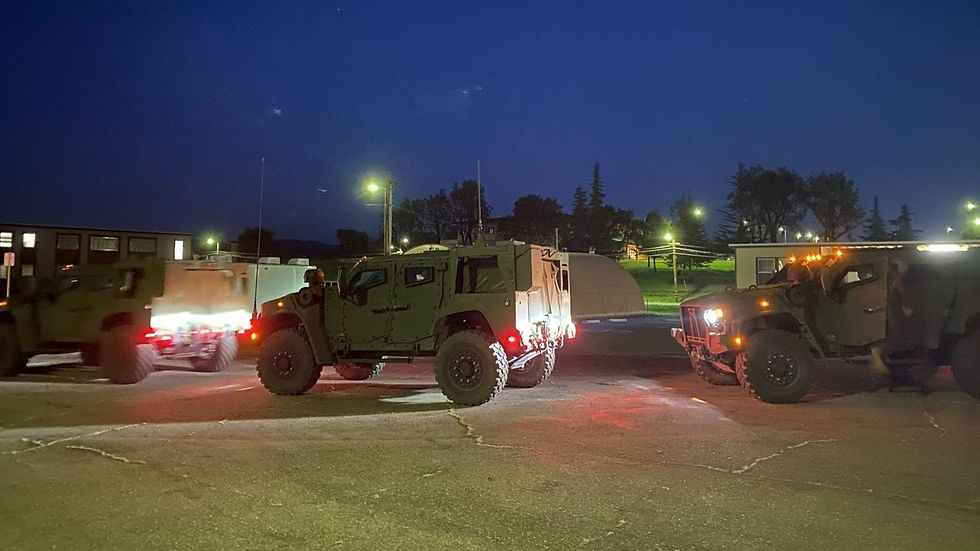
Members of the 351 Civil Affairs Command Conduct JLTV Training at a training facility located in Northern California
The U.S. Army also standardized California's older Spanish-Mexican movement corridors into an American military spine. Three corridors were prominent: the Peninsula axis along El Camino Real, the northern gateway through the Carquinez Strait, and the inland loop through the Diablo Valley. These corridors explain why later installations, Moffett Field, Benicia Arsenal, Mare Island, Camp Parks and others, ended up where they did. In California, infrastructure and command geography are not separate concepts. They are co-produced over time.
World War II and the Birth of Civil Affairs in California
World War II marks the single greatest acceleration in California's civil-military evolution. The Bay Area transformed from a regional military hub into a global center of mobilization, logistics, and governance. The density of wartime capacity packed into one metropolitan region was striking. The Presidio served as headquarters for Western Defense Command. Mare Island and Hunters Point produced and repaired naval vessels. Benicia Arsenal supplied the Pacific Theater. Richmond's Kaiser Shipyards built Liberty ships at unprecedented speed. Camp Parks, Camp Shoemaker, and Camp Stoneman formed an inland training and deployment complex. The region's colleges, Stanford, Berkeley, Santa Clara, Saint Mary's, provided engineering talent, scientific research, and administrative expertise. This was the Bay Area operating as a civil-military ecosystem, not a set of separate actors.
For the Civil Affairs community, the most significant wartime development was the establishment of the Civil Affairs Staging Area at Monterey (CASA). CASA trained officers for civil affairs and military government in the Pacific Theater, preparing them to govern liberated territories, restore essential services, and stabilize societies emerging from Japanese occupation[viii]. CASA did not invent civil affairs, but it scaled the discipline and molded it to the demands of the Pacific. Its curriculum addressed governance challenges in Japan, the Philippines, Okinawa, Korea, and Pacific island territories. It drew heavily from Bay Area universities and municipalities for instruction in public administration, civil law, engineering, public health, economics, and regional studies. CASA's location in Monterey was not incidental. Monterey had served as the administrative capital of Spanish and Mexican California, paired with San Francisco as the forward military node since the 1770s.

351st Civil Affairs Command Civil-Military Planning at the Naval Post-Graduate School near the Presidio in Monterey. (L-R): COL Riffle, MAJ McClure, COL Larson, and MAJ Li
Today, the mantle of civil-military operations is carried by Civil Affairs (CA) units. These specialized forces are the Department of Defense's primary tool for understanding and engaging with the civilian population in any operational environment. Their mission is to build networks, provide expertise in governance, and support the commander's objectives by working with and through local leaders and institutions. The 351st Civil Affairs Command is a key player in this global mission.
Viewed in this lineage, the institutional arc from the Spanish presidios through CASA to the 351st Civil Affairs Command at Moffett Field is a traceable chain of civil-military governance capability in the same regional system.
The Modern Moffett Complex: The Thesis in Miniature
When the Presidio closed under BRAC in 1994, the Bay Area's civil-military system did not disappear. It reconcentrated. Moffett Field absorbed the civil affairs mission, the psychological operations mission, the aerospace research mission, and eventually the defense innovation mission. Camp Parks persisted as the inland training and reserve node. Lawrence Livermore National Laboratory and Sandia continued to anchor the inland research corridor. The universities never left. The commercial technology sector expanded massively.
What was lost is real. The Presidio's direct military command presence in San Francisco, the visible daily presence of uniformed military in the Bay Area's civic life. However, the functional system, the research, the governance capacity, the innovation bridging, the training depth, reconcentrated rather than dissolved.

Members of 351 Civil Affairs Command with Mrs. Arroliga during a Training Session
Today, Moffett Field hosts four institutions that, taken together, represent the Bay Area's civil-military node in miniature. NASA Ames Research Center conducts aerospace, computing, AI, and simulation research with deep ties to Stanford and Berkeley. The 351st Civil Affairs Command, commanded by COL Keenaghan, serves as the Army's primary civil affairs headquarters for the Indo-Pacific, carrying forward the governance and stabilization mission. The 7th Psychological Operations Group, formerly headquartered at the Presidio, now subordinate to the 351st, adds information operations to the civil-military mission set. And the Defense Innovation Unit serves as the Pentagon's mechanism for coupling Silicon Valley's commercial technology ecosystem to military capability.
The 351st's mission at Moffett is not abstract. Civil affairs involves direct engagement with local populations to minimize the impacts of military operations and to facilitate stability. That work is operationalized through structures like the Civil-Military Operations Center and the Government Functional Specialty Teams, soldier-experts in fields such as rule of law, public safety, critical infrastructure, and economic stabilization who apply professional depth to support the broader mission[ix]. This integrated approach allows commanders to apply specialized knowledge precisely where it is needed, enhancing the relationship between military forces and the civilian populace.
The concentration of that capability at Moffett, adjacent to a federal research center and a defense innovation unit, in the heart of the world's most productive information technology ecosystem, is not coincidence. It is the system working as it has worked for 250 years: concentrating complementary capabilities along the same corridors, in response to the strategic demands of the era.

The Civil Affairs Synchronization Working Group (CASWG)
Implications for Civil Affairs
From the Spanish soldiers governing colonial settlements to the specialized Civil Affairs teams operating out of Moffett Field today, the Bay Area's military history is a continuous narrative of civil-military partnership. This legacy has been less about projecting force than about building stability, managing complex civic challenges, and forging relationships. As the nature of global conflict continues to evolve, that long-standing tradition remains more relevant than ever.
The Bay Area's civil-military history suggests three propositions worth serious consideration within the Civil Affairs community.
First, civil-military governance in California is not a twentieth-century invention. It has been a structural feature of the region since 1776. The branch's institutional memory tends to begin with World War II. The California record suggests the roots run deeper and that the patterns established by the presidio-mission system, the U.S. military government, and CASA continue to shape how civil affairs capability concentrates and operates in the Pacific.
Second, geography matters. The corridors that carried Spanish presidial marches, Mexican ranchero settlement, and U.S. Army columns are now the arteries of the global center of information technology and technical innovation. Basing decisions that appear bureaucratic are often the product of terrain and institutional inheritance accumulated over centuries. Understanding that inheritance is itself a form of operational preparation of the environment.
Third, the co-location at Moffett Field is a strategic asset, not an administrative convenience. Civil affairs, psychological operations, defense innovation, and federal research concentrated on a single installation, drawing from the same regional talent base, in the heart of the world's most productive dual-use innovation ecosystem, is a configuration with few parallels.
About the Author:
Captain David Clinnick is in the U.S. Army Reserve and assigned to the 351st Civil Affairs Command in Mountain View, California. He holds a PhD and MA in archaeology from Durham University, a BA from Saint Mary's College of California, and completed a fellowship at Harvard University. His research interests include the institutional history of civil-military governance, cultural property protection, and evolutionary studies.
The views and opinions expressed in this article are those of the author and do not reflect any official policy or position of the U.S. Army, the Department of Defense, or any other U.S. government agency.
[i] Warren L. Cook, Flood Tide of Empire: Spain and the Pacific Northwest, 1543–1819, Yale Western Americana Series 24 (New Haven: Yale University Press, 1973).
[ii] Zephyrin Engelhardt, O.F.M., San Francisco or Mission Dolores (Chicago: Franciscan Herald Press, 1924).
[iii] Richard Dillon, Siskiyou Trail: The Hudson's Bay Fur Company Route to California (New York: McGraw-Hill, 1975).
[iv] Walter Colton, Three Years in California (New York: A.S. Barnes & Co.; Cincinnati: H.W. Derby & Co., 1850).
[v] John B. McGloin, S.J., California's First Archbishop: The Life of Joseph Sadoc Alemany, O.P., 1814–1888 (New York: Herder and Herder, 1966)
[vi] Allan Nevins, The State Universities and Democracy (Urbana: University of Illinois Press, 1962).
[vii] California Postsecondary Education Commission, California Colleges and Universities, 2008: A Guide to California’s Degree-Granting Institutions and Degree, Certificate, and Credential Programs, Commission Report 08-01 (Sacramento: California Postsecondary Education Commission, March 2008).
[viii] United States Civil Affairs Holding and Staging Area, Presidio of Monterey, California, Cases and Materials on Military Government ([Presidio of Monterey, CA]: Civil Affairs Holding and Staging Area, January 1945).
[ix] Department of the Army, FM 3-57: Civil Affairs Operations (Washington, DC: Headquarters, Department of the Army, 2021).


